

A Day on the Wards, from Admission to the Bill
A day on the wards, from admission to the bill — the real software, with made-up patients.
The bed board, an admission, the round, the nursing chart, the emergency, the theatre, the bill and the reports. The real software, with made-up patients.
About 8 minutes
The Narration
What the film says, in order.
- Nirnoy General Hospital, on one screen for the owner: a briefing each morning, then the beds, today’s money, the emergency and the theatre — on the hospital’s own computer.
- The menu folds to its icons for more room, and any screen is found by typing its name — in Bangla or English.
- The bed board: who is in which bed, which beds are ready and which are being cleaned — every ward, cabin and the ICU.
- A patient is admitted to a ready bed: the consultant, the reason, the attendant’s phone — and the bed’s own daily rate.
- Every stay is one page: the consultant, isolation, blood requests, the lines and tubes in place, and every doctor’s note.
- A signed round goes straight to the ward’s printer: the orders, the saline and the instructions — in Bangla, for the nurses.
- Nurses chart the observations at the bedside, and the early warning score is worked out as they go.
- The medicine chart comes from the doctor’s orders. Every dose given is signed for, and one not given needs a reason.
- Each doctor sees their own patients across the wards, with what has changed since their last round — and notes go in by voice: tap, say the bed and the note, and it opens listening.
- A round said aloud at the bedside: the blood pressure, pulse and temperature go into the vitals by themselves, the rest into each box by its name — and once signed, the vitals are on the observation chart too.
- Instructions are read as they are written: sponging for fever may stay, but NICE’s advice against it is shown beside it, with where it comes from — a reminder, never a block.
- A patient who cannot come down to the lab: the doctor asks for the sample at the bed, and the lab’s screen and phone ring until someone answers — and if nobody does, more people are told.
- The lab person answers that they are going, and the tube stickers print to carry to the bed; the ward sees who is on the way, and when.
- Emergency: arrivals triaged by colour, the wait on every card, and a ward bed in one step.
- The operating theatre: the day’s list, the surgeon and the anaesthetist, from booking to recovery.
- The blood bank: requests from the wards, bags cross-matched and held for a patient, and every bag traced.
- Controlled drugs: every dose given with a witness, and each ward’s stock counted.
- Infection control: who is isolated, every line and catheter and how long it has been in.
- The CSSD: every instrument set by its tag — used, cleaned, sterilised, and back on the shelf.
- The kitchen cooks from the doctors’ own diet orders, and nobody nil by mouth is sent a tray.
- Ambulances: a transfer asked for by the ward, the driver given, the trip and its charge on the bill.
- The duty roster: which doctor covers which ward, morning, evening and night — the open shifts drafted by rule, then changed box by box.
- Housekeeping and support work: a supervisor for each floor, routines for each role, printed slips for staff without the app, and what is running late.
- The vaccination register: each child’s EPI schedule from birth — given, due and overdue — and every dose with its lot, site and who gave it.
- The due list: every child due or overdue in the days ahead, to call or to print — and beside each, what becomes of the parents’ reminder.
- Parents get an SMS the evening before, at the hour the hospital sets, naming the doses and the EPI corner’s room; one the evening missed goes the next morning.
- A hospital may ask for its patient card before an outpatient is served. The desk issues it in a minute: a photo, the NFC chip tapped on, the emergency details the patient agrees to show, and its fee on the same visit.
- Printed on a PVC card with its QR code. One tap or scan finds the patient at every counter, ward and lab; with a PIN the patient opens their own record from the QR; and the emergency details show only if the patient agreed.
- An outpatient’s tests at the counter, as at a diagnostic centre: part paid now, the rest when the report is collected.
- In the lab, the analyzer’s results land in the report by themselves — Sysmex, Mindray, Roche, Abbott, over the network or a cable — each against the right tube and test.
- Every kind of written report has its own form — ultrasound, X-ray, CT, ECG, echo, culture — with its sections in order and the normal wording ready. The AI can make one from the hospital’s own sample reports, for a doctor here to read first.
- When the doctor who ordered the tests has their own Nirnoy Rx linked, the counter asks the patient first — one plain statement naming that doctor — and no report goes without a yes.
- Or the statement prints on a slip to sign or thumb-print, kept on file. Once the tests are paid and approved, the report goes to the doctor’s own app, encrypted all the way.
- Where the hospital turns it on, a prescription signed in its own OPD waits at its own pharmacy — only if the patient says yes, never at a leased one — and management sees which were filled here and which went elsewhere.
- The hospital sets when patients pay: an inpatient at release, and each outpatient service before or after it — tests as at a diagnostic centre.
- Company and insurance patients: the panel’s agreed discount, the patient pays only their own share, the rest is billed to the company — and its claim prints for the month.
- The bill grows with the stay: each night at the bed’s own rate, every test and medicine — settled on the day the patient goes home.
- Nobody is let go with the bill unpaid — unless a manager allows the due, or it is settled with an approved discount, kept in its own register.
- Ready to go home: what still stands between each patient and the door — the summary, the medicines, the bill.
- Text messages go from a Nirnoy Rx package or through the hospital’s own gateway — BD Web Services, Alpha SMS, BulkSMSBD, or any other.
- And if the hospital wants it, a deposit paid online before a visit — through its own bKash or SSLCommerz, given back by itself when a patient cancels in time.
- Reports for every part of the hospital — bed occupancy, admissions, length of stay, theatre — charted, and downloaded as Excel.
- And the ones that matter go to the owner by email every morning, week or month, with the Excel file attached.
- Every night an agent closes the day: it checks the books, keeps the day’s figures, and anything that does not add up becomes an alert — it never edits or guesses.
- Signing in is guarded: two-step sign-in by role or by email, fingerprint or face, an address blocked after repeated wrong passwords, and each role allowed only from the networks chosen for it.
- Medical records are guarded: two-step sign-in, roles with limits, a sealed audit trail, and a log of who opened which record.
- See it for your hospital. Write to [email protected], or start at nirnoyrx.com/hospitals.
More Films
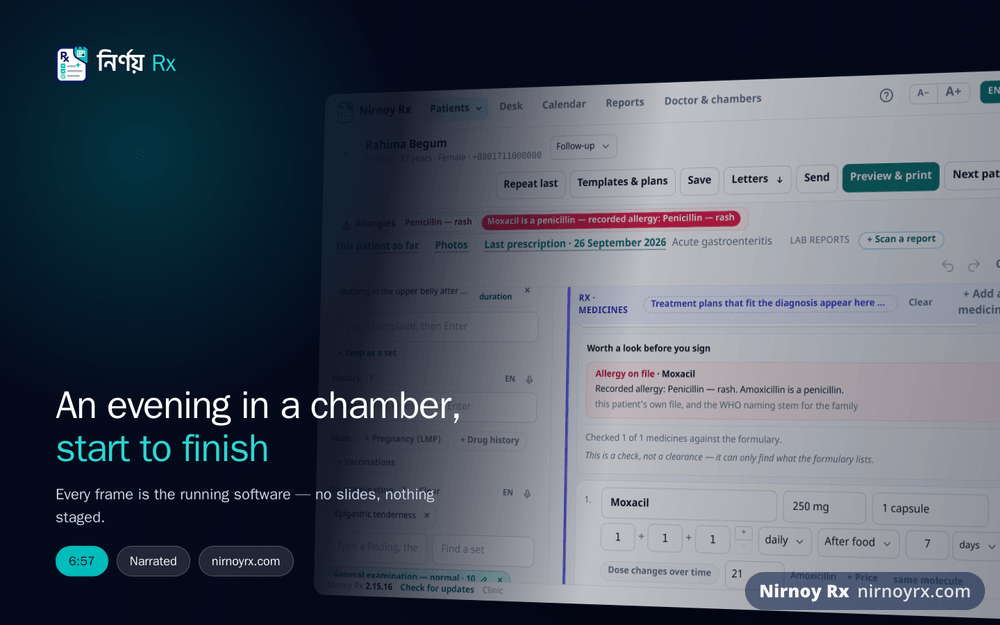
A walk through Nirnoy Rx
The prescription, inhalers and insulin, the patient’s phone, lab warnings, a child’s growth, photos, online serials and the registers, for a doctor’s own chamber. · About 8 minutes
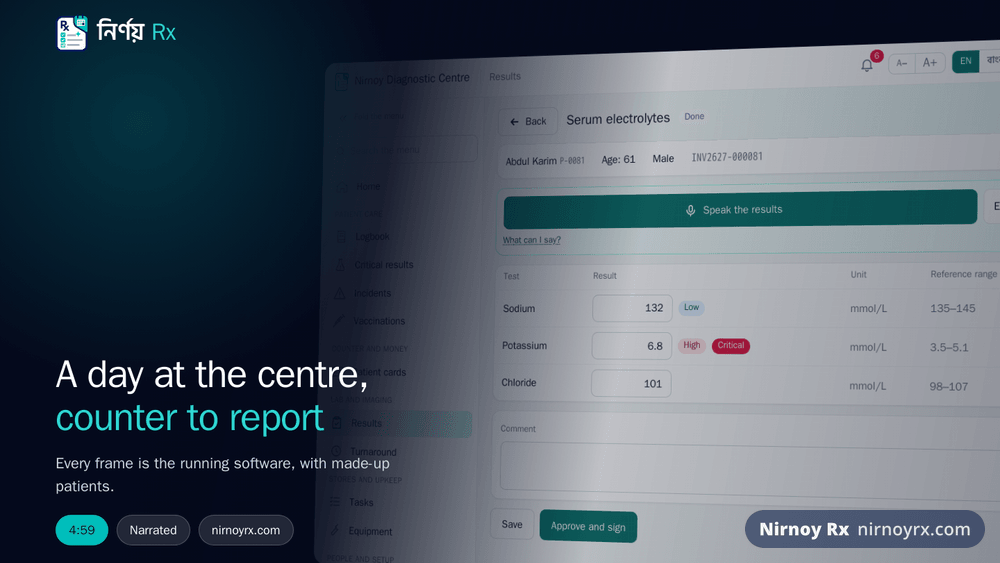
A day at a diagnostic centre, from the counter to the report
Registration, the tubes, the results, a critical value, the report and the accounts behind it. The real software, with made-up patients. · About 7 minutes
Start Today
Try it free for 14 days: the whole thing, no card. If it does not suit you, delete it. Or buy it outright, if you would rather.