

A Walk Through Nirnoy Rx
A walk through Nirnoy Rx — the prescription, inhalers and insulin, the patient’s phone, lab warnings, a child’s growth, photos, online serials and the registers
The prescription, inhalers and insulin, the patient’s phone, lab warnings, a child’s growth, photos, online serials and the registers, for a doctor’s own chamber.
About 8 minutes
The Narration
What the film says, in order.
- This is Nirnoy Rx. It is installed on the doctor’s own computer — no website to log into, no account to forget.
- The practice is set up once — the degrees, the BMDC number, each chamber and what it charges.
- Every patient ever seen is on the register — by name, by patient number, or by phone.
- Their file carries every earlier visit, every medicine given, and at the top, their allergies.
- The first time, it asks where you would like to write: the detailed pad, or the printed page itself — and you can switch at any time.
- A new prescription starts from that file, not a blank page — the history is already there.
- Complaints, examination, diagnosis — typed or spoken. Type APD, and acid peptic disease comes up, short form and all.
- And it counts his own past visits as he types. Nine of your last fourteen — your habit, not advice.
- The medicine list is the DGDA register — thirty-eight thousand two hundred and two, by brand or generic.
- And it checks as you write: this patient is allergic to penicillin. That check runs here — free, offline, always the same answer.
- The warning sits on the line it is about, and the top of the pad counts what is still to be looked at.
- Print with a serious warning still on it, and it asks once. It is a check, not a clearance — the doctor decides.
- The dose can be said in words — three times a day for seven days after food — and the boxes fill themselves.
- Said in Bangla and heard wrong? It offers the right words — one press each — and it never changes a number.
- Heard again, the medicine comes out right: three times a day, after food, if the fever continues.
- Where Bangla is often misheard, clearer dictation with AI can be turned on — with its price shown first.
- No microphone on the computer? The doctor’s own phone becomes one. Press the microphone beside a box, and the phone is ready for it.
- Speak into the phone, and the words arrive on the computer as they are said — only the words, never the sound.
- Any line shows other brands of the same molecule, priced per dose at the prices you recorded — prices the patient never sees on paper.
- Treatment plans from the national guidelines come as templates — tick one, take only the parts you want, and read it before anything goes on the pad.
- A photographed lab report is read into the visit — and whatever it could not read, it names.
- The AI reads the whole file and summarises it — and says what that costs before spending anything.
- Two ways to pay: your own provider key, or credits from us. Either way the spending is on screen.
- Inhalers, sprays, insulin and injections are written their own way — puffs, each nostril, units under the skin.
- And the notes that go with each one come up by themselves: rinse the mouth, shake before use, keep it in the fridge.
- And it reads the patient’s own reports against what you write. Metformin, at an eGFR of twenty-eight — it says so, with the report’s date, before you sign.
- Every test measured more than once becomes a chart — the creatinine climbing, the HbA1c coming down.
- Reports from a linked diagnostic centre arrive by themselves — the centre’s own figures, put with the right patient, the unread first.
- Read one, and say whether the patient needs to come. The list keeps track of who is still undecided.
- A centre that keeps its own laboratory software sends its own pages, naming the branch that did the test — and nothing is read into figures here.
- It prints on the doctor’s own pad. At the foot is a QR code holding the prescription itself, signed with this practice’s key.
- In the preview, every section’s sets sit beside the sheet: press one and it is on the prescription, or keep what is there as your own.
- The patient scans it: the medicines in Bangla, large, with the times of day — and the doctor’s signature checked on their own phone.
- English is one press away, for whoever wants it.
- And a reminder: the medicine times go into the phone’s calendar or alarm, and stop by themselves when the course ends.
- A referral letter is made out of the record — findings, today’s medicines, the lab values that moved.
- It prints on his own letterhead — every line his own words, or a laboratory’s own figure.
- Certificates are written the same way — sick leave, fitness, travel — from the record, numbered, over the BMDC number.
- A child is read against the WHO growth curves as the numbers go in, and every visit goes on the chart.
- And the EPI schedule runs from the date of birth — which dose is due, which is overdue, card or no card.
- For a child, the dose is worked out by weight from the doctor’s own milligrams per kilo — and a syrup is written as the spoon it is.
- Set up from your own pad: one photograph, and the AI reads your name, degrees, footer and logo — all laid out to check before anything is kept.
- If the pad has blanks for the patient’s name, age and date, it finds those too.
- Then each value prints into its own blank — drag a box to move it, and print a check on plain paper to hold against the pad.
- And the look is yours: a soft colour for the header, the column and the footer, and a faint picture for your speciality.
- And the Rx column can sit on either side — on the paper, in the preview and on the pad alike.
- With the patient’s consent, before-and-after photos of a rash or a wound, compared side by side — and kept only in the practice file.
- The evening before, the desk shows who is due back tomorrow, and whose medicine is running out. A reminder is one press, with its cost on screen.
- The desk is tonight’s serials — who has arrived, who is with the doctor, what has been taken in fees.
- And the calendar: every day’s serials, appointments and follow-ups, with a serial given for a day ahead.
- Three chambers, three shares of the fee, one question — what is still owed, and by whom.
- And the disease registers: every diabetic and hypertensive in the practice, and who is overdue for what.
- Patients take a serial from the chamber’s own link on their phone — with a bKash deposit, if the doctor asks for one.
- Their own link shows their number and roughly when to come, and it moves if the evening runs late.
- A screen for the waiting room: the number being seen, and how late the evening runs.
- And the assistant works the queue from their own phone — on the chamber’s wifi, or from anywhere, with everything sealed.
- Try the whole of it free for fourteen days — nothing to pay, and nothing to cancel.
- Then it is bought once and it is yours. Start at nirnoyrx.com, or write to [email protected].
More Films
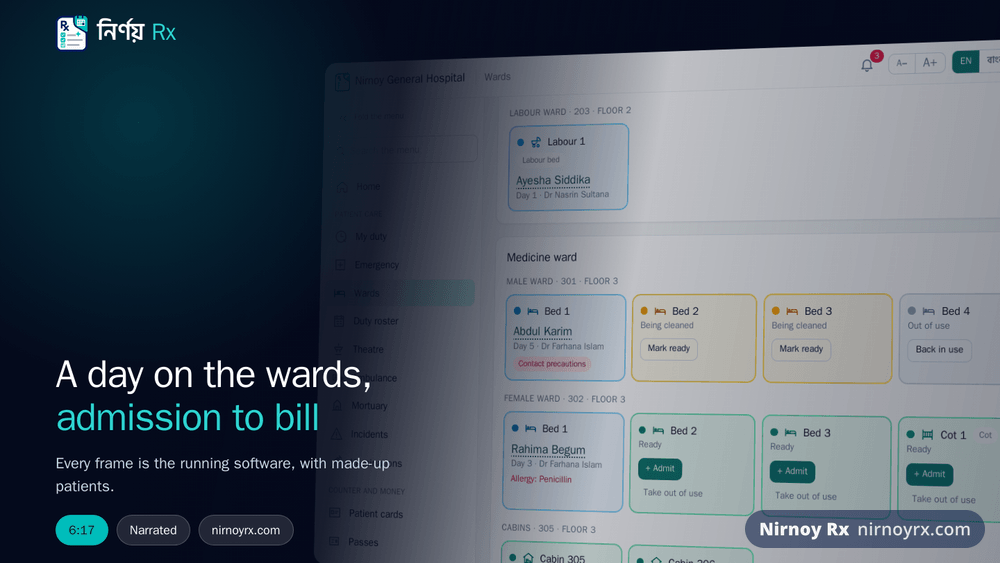
A day on the wards, from admission to the bill
The bed board, an admission, the round, the nursing chart, the emergency, the theatre, the bill and the reports. The real software, with made-up patients. · About 8 minutes
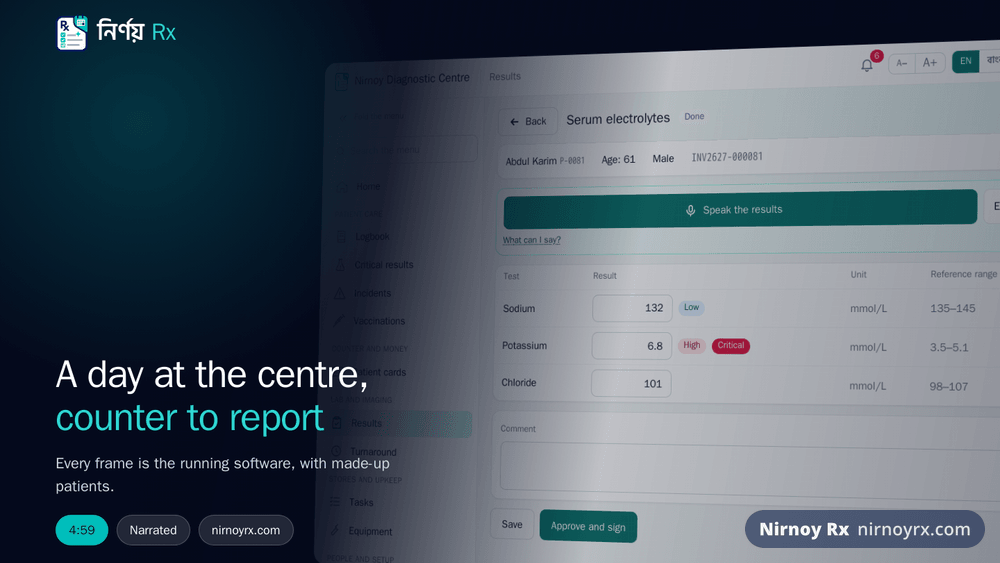
A day at a diagnostic centre, from the counter to the report
Registration, the tubes, the results, a critical value, the report and the accounts behind it. The real software, with made-up patients. · About 7 minutes
Start Today
Try it free for 14 days: the whole thing, no card. If it does not suit you, delete it. Or buy it outright, if you would rather.