

Hospital and clinic management software in Bangladesh
Admission to discharge — every dose, every signature, every taka
The bed board, emergency, rounds, the nursing chart, theatre, the blood bank, controlled drugs, infection control, CSSD and the bill — on the hospital’s own computer, with or without the internet. Doctors and nurses work as themselves, on their own phones. The pictures below are the real software, captured running with made-up patients.
One patient’s way, start to finish
Who does the work at each step, and what the software does. Press a step to stop on it.
- 1 Arrival Emergency or outpatients Triage — red, yellow, green; a red arrival tells the doctor on duty at once.
- 2 Admission and a bed Admission desk A ready bed from the board, the deposit, the attendant’s phone.
- 3 The ward round Ward doctor Written or spoken; allergies and doses checked before signing; printed on the ward once signed.
- 4 The orders arrive Pharmacy, lab, blood bank, kitchen The round’s medicines, tests, blood and diet reach each of them — nothing written twice.
- 5 The nursing chart Nurse Every dose on time, the patient’s card scanned; a witness for controlled medicines; the early warning score from observations.
- 6 The operation Surgeon, anaesthetist, theatre When needed: consent, the WHO checklist in order, the sterile sets traced to the patient.
- 7 The bill builds Accounts Each night at that night’s rate, medicines and tests as given; the family texted when the deposit runs low.
- 8 Going home Doctor and desk The discharge summary signed, the final bill, unused medicines back.
- 9 The summary on the patient’s phone Patient and family The signed discharge summary arrives by SMS as a private link — the medicines to take home and the follow-up, Bangla first; “Remind me” sets the medicine alarms.
- 10 The bed made ready Housekeeping The bed “being cleaned”, then “ready” — on the board for the next patient.
Beside every patient, all the time
- Infection control
- CSSD and laundry
- Controlled-drug register
- Critical results and incidents
- Duty roster and handover
- The owner’s dashboard
- Serial number and time by SMS
- Feedback by SMS after going home
Admissions and the bed board
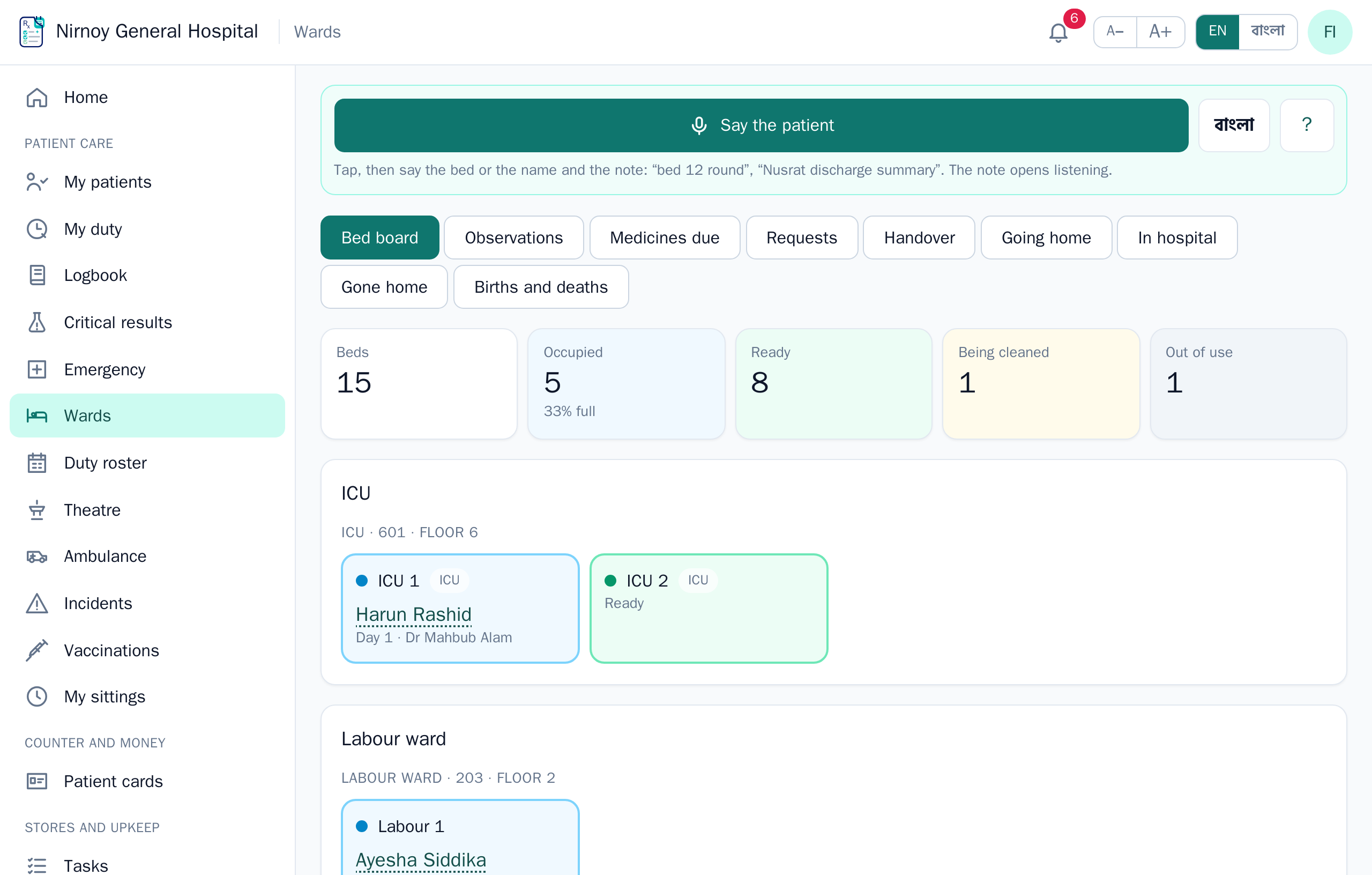
Every bed at a glance
Who is in each bed, the day of their stay, their doctor, allergies and any isolation — ward by ward. Admit to a ready bed, move beds, take deposits; after discharge the bed is “being cleaned”, then “ready”. Set the going-home day and what is left to do is listed apart.
- Beds, cabins and ICU — each with its own rate
- The desk told and the family texted when a deposit runs low
- Isolation shows on the bed, and the nurses are told
Emergency
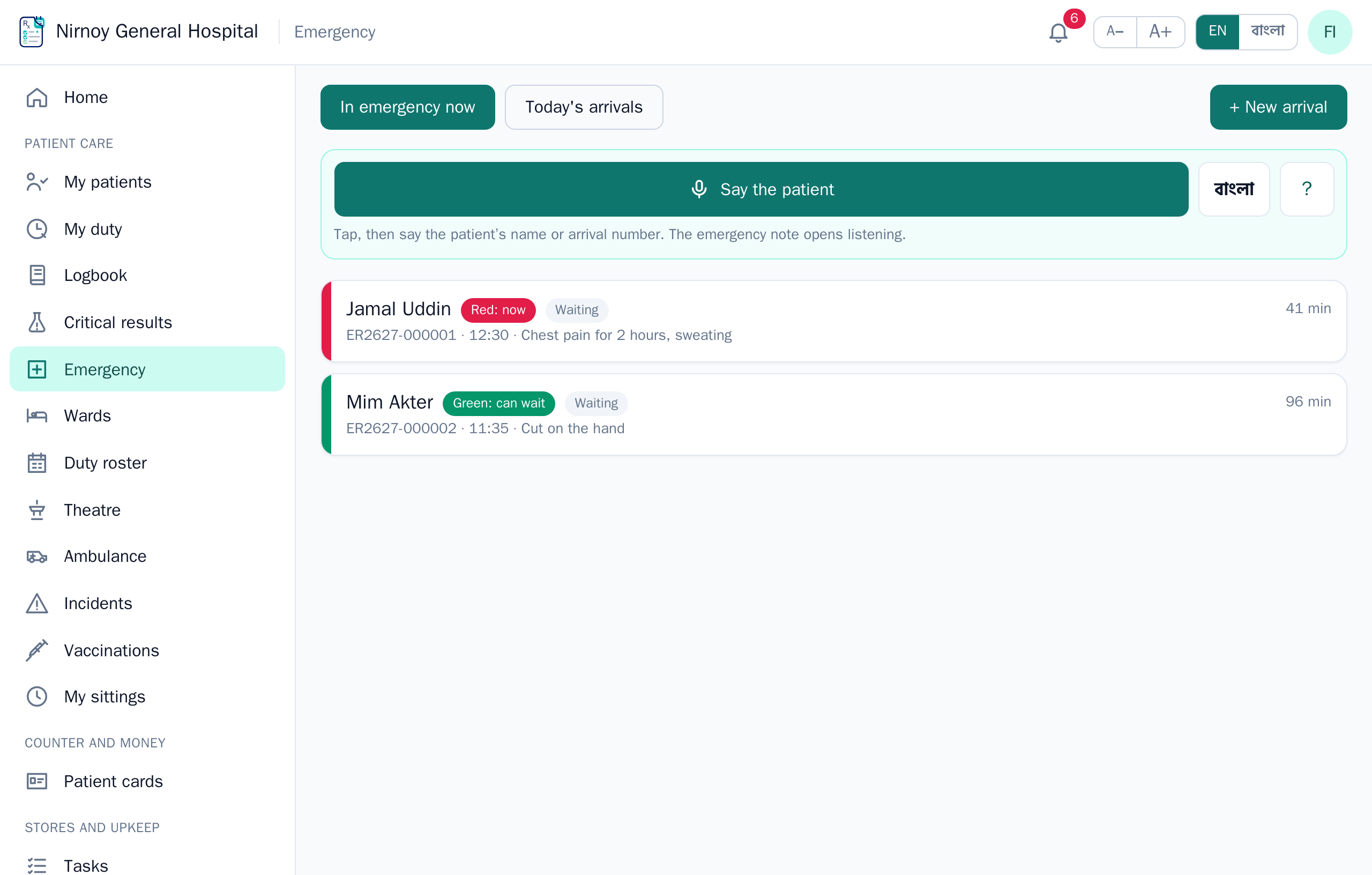
The one who must be seen first, first
Triage on arrival — red, yellow, green — and how many minutes each has waited. A red arrival reaches the doctor on duty’s phone at once. From the emergency note: admit, home or refer; the referral letter is drafted from the note, and the ambulance is one press away.
- “Say the patient” — say the name or arrival number and the note opens
- The referral letter prints once signed, with the reason and condition
Rounds, by voice
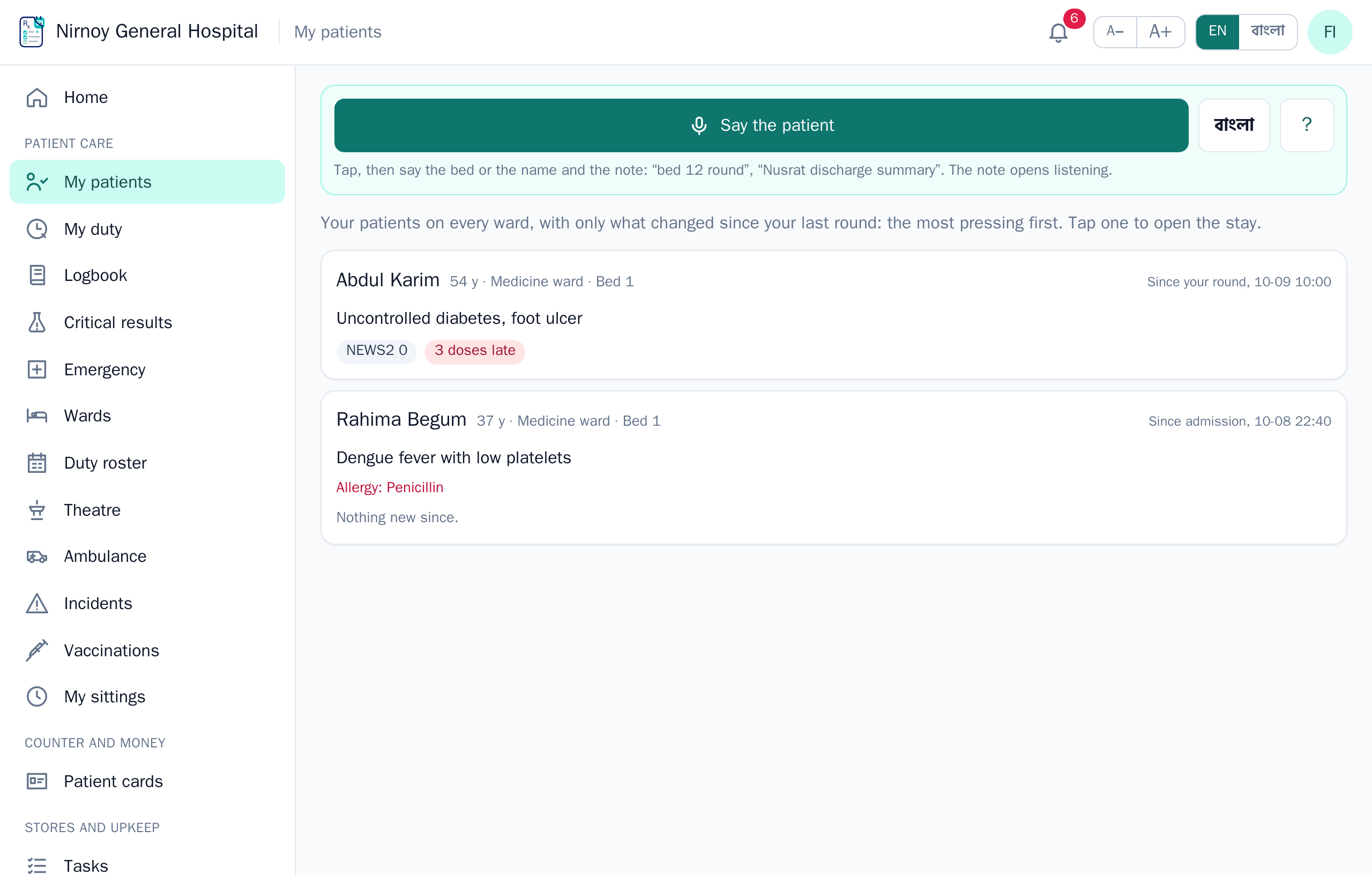
A whole round without touching the phone
Say “bed 12 round” and that patient’s note opens with the last round’s medicines ready. Say a box’s name to go to it, then speak — in Bangla or English. Say “sign” and the note is read back; “yes”, and it is signed and printed on the ward. Allergies and doses are checked before it signs.
- “My patients” — what changed since your last round, the most pressing first
- A signed note never changes
The nursing chart
Every dose on time, every delay in sight
The round’s medicines put themselves on the chart. Doses in the next two hours and those running late are on top; given, refused or held — with the reason. The patient’s card is scanned before giving. A controlled medicine records what was used, what was thrown away and a witness — in the chart and the register together.
- The early warning score from observations; a high one tells the doctors
- The shift handover drafted from the chart


Medicines due
The operating theatre
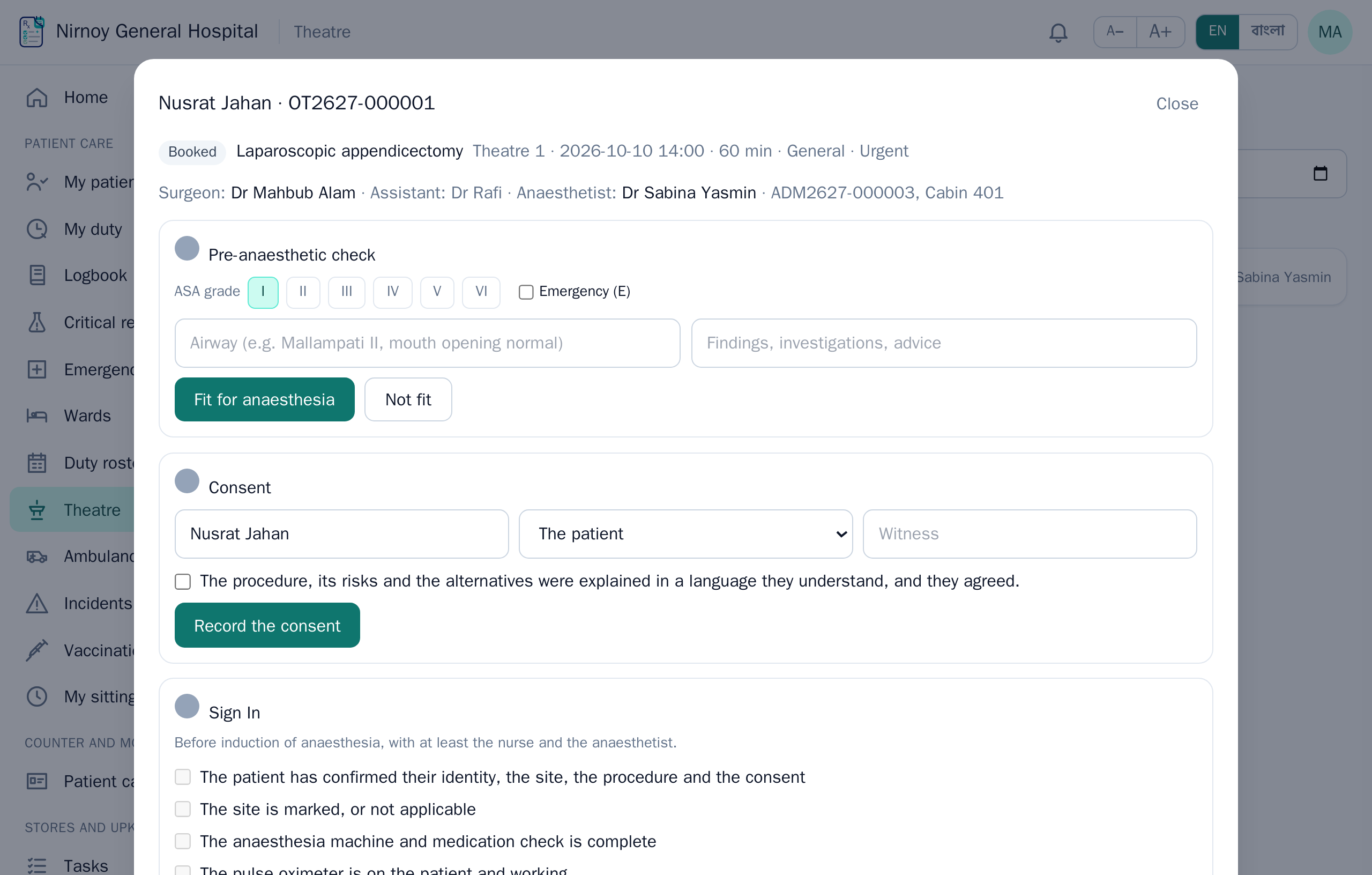
Every answer of the checklist, in order
Booked by theatre, time, procedure and side — two operations never share a theatre at once. The pre-anaesthetic check and consent, then the WHO surgical safety checklist — Sign In, Time Out, Sign Out — each opening only when the last is done. The operation and anaesthesia notes, and the recovery scores.
- The sterile sets used are linked to the operation
- From recovery to a ward, ICU or home
Controlled drugs
Every ampoule accounted for
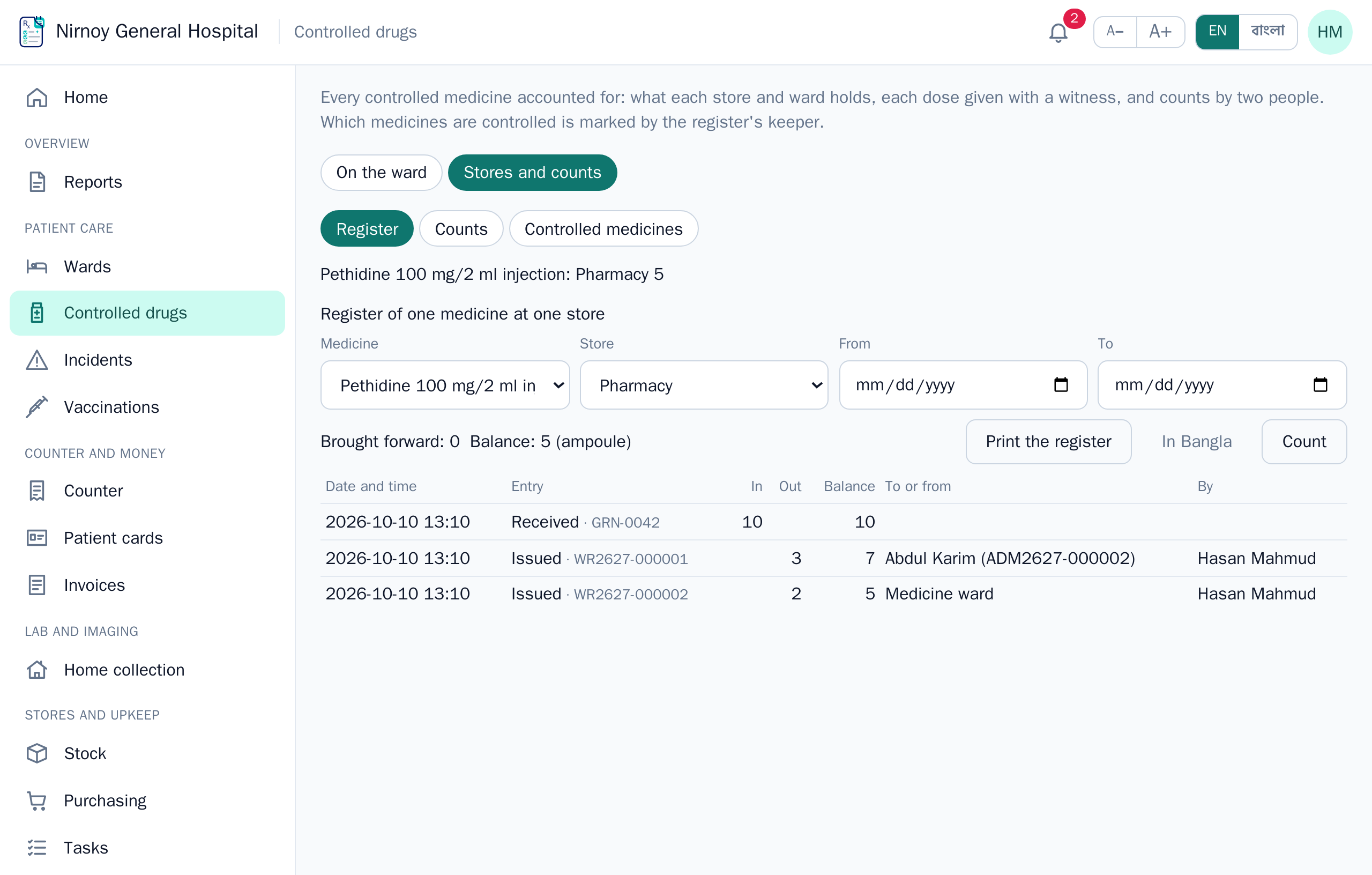
The hospital’s register keeper marks which medicines are controlled. Each store’s and ward’s register keeps its running balance; each dose has a witness who types their own password; counts are made by two, and a difference is reported at once. A wrong entry is never deleted — it is struck through with the reason and a witness.
- The register printed in Bangla or English, for signing
Infection control
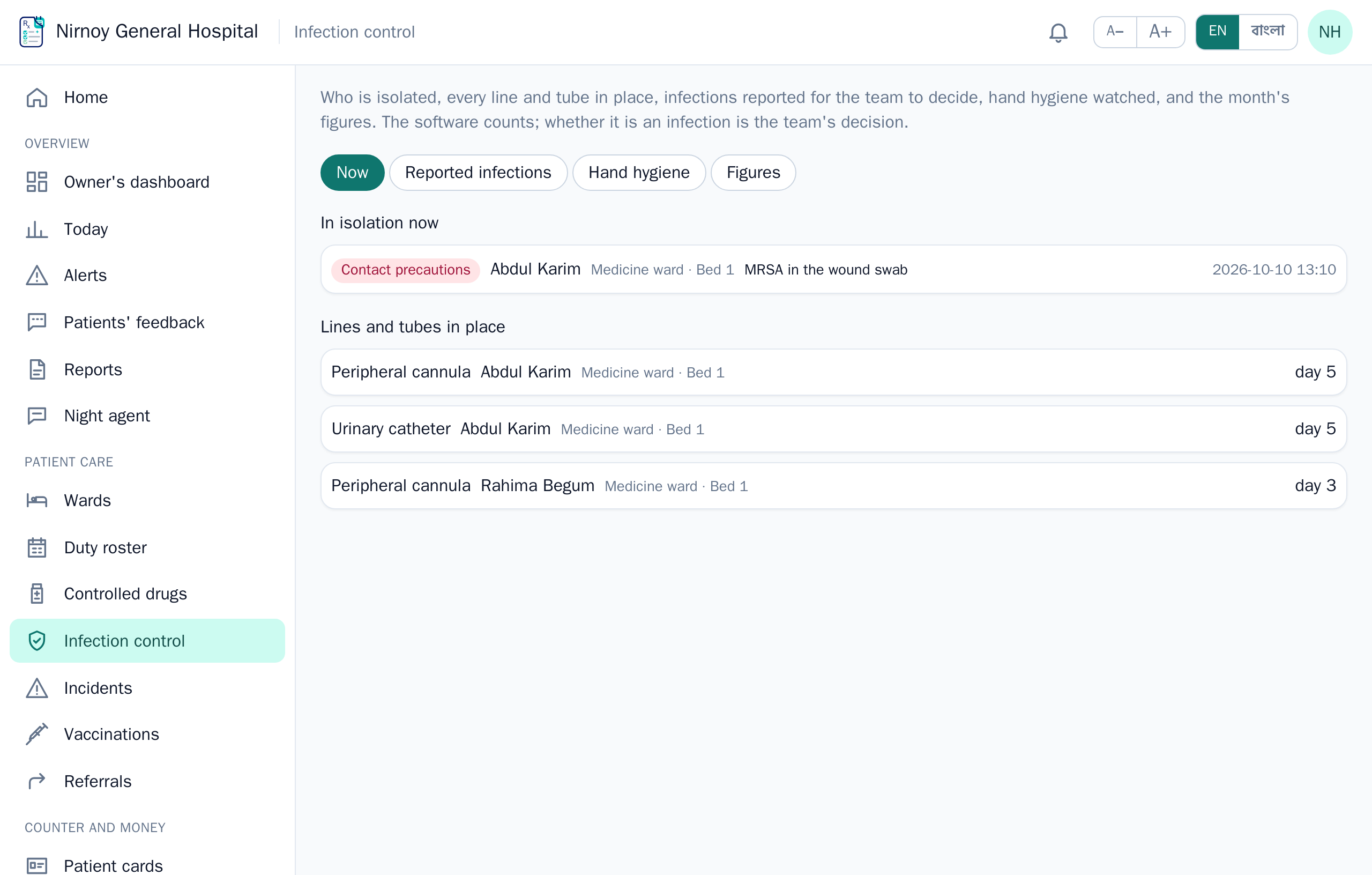
Who is isolated, and how long each line has been in
Isolation — contact, droplet, airborne or protective — with the reason, shown on the bed. Central lines, catheters, ventilators and cannulas, and how many days each has been in. A suspected infection is reported from the ward; only the infection control team confirms it. Hand hygiene by the WHO’s five moments, and the month’s rates per 1,000 device days.
- The software counts; whether it is an infection is the team’s decision
CSSD and laundry
Every set from the sterilizer to the patient
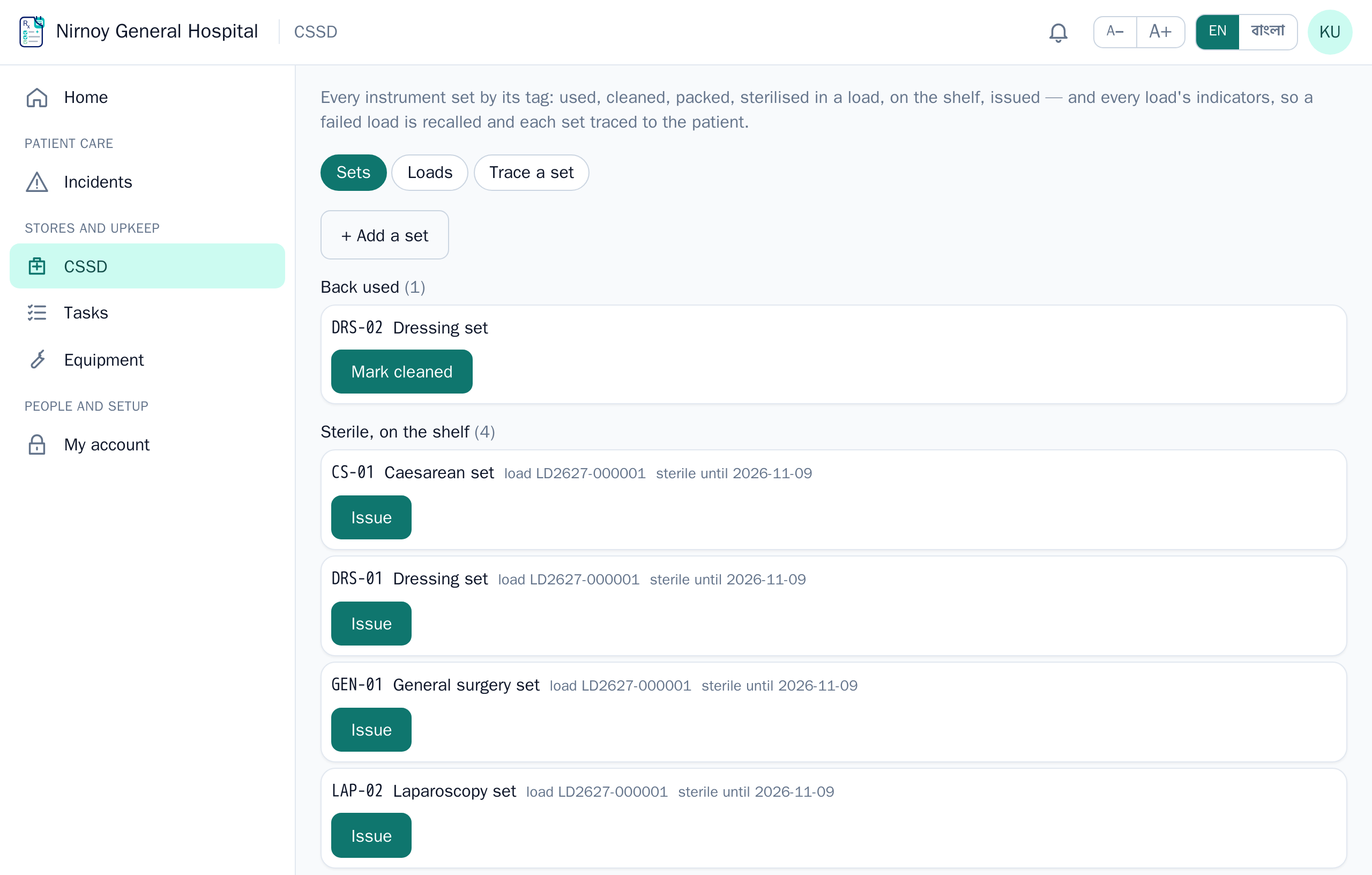
Each instrument set by its tag: used, cleaned, packed, sterilised in a load, on the shelf, issued. Every load’s Bowie-Dick, chemical and biological indicators; a failed biological indicator recalls the whole load, and the theatre is told which set went to which patient. In the laundry, linen counted out and back, infected apart.
- A set past its sterile date cannot be issued
- An implant set waits for its biological result
And more
The rest of the hospital
Blood bank
Donors and bags; a bag is used only once HIV, hepatitis B and C, syphilis and malaria are all negative. Only bags the patient can receive are offered; cross-match, issue, and a two-person check at the bedside.
Details and pictures →
The inpatient bill
Beds each night at that night’s rate; what the pharmacy issues at its sale price, credited when it comes back; operation packages with the extras apart; a panel patient’s bill split between the panel and the patient.
Details and pictures →
The AI scribe
Where the hospital allows it and the doctor turns it on: with the patient’s agreement, it listens and drafts the note. The doctor checks every box before it goes in; medicines never go in by themselves; the recording is not kept.
Details and pictures →
Postgraduate logbook
Cases gathered from a trainee’s stays, emergency patients and operations — without who the patients were; printed for the supervisor to sign.
Details and pictures →
Kitchen
Each meal’s list from the diet written on the round; nil by mouth gets no tray; allergies show.
Details and pictures →
Passes and the gate
Passes for attendants and visitors — a QR on paper or an NFC card; scanned at the gate. Opening doors needs the hospital’s own locks connected.
Details and pictures →
Ambulance
Asked for by the desk or a doctor; the right kind is given; the driver moves the trip on from a phone; the charge goes on the bill.
Details and pictures →
Births, deaths and the mortuary
Births and deaths recorded and certified; a body is released after certification and, for a police case, clearance, to a named person with ID — never held back for a bill.
Details and pictures →
The counter, the lab, the pharmacy, the accounts and payroll — all from the diagnostic centre edition, in the same system.
Questions
What hospitals ask
What is the best hospital software in Bangladesh?
Does the ward stop when the internet goes?
Does the software make clinical decisions?
Is everything from the diagnostic centre in it too?
Will it suit a small clinic?
What does it cost?
See it running at your hospital
Tell us your beds and departments — we will show it to you and quote.