

The hospital and clinic · Outpatients
OPD contracts: doctors, rooms and rent
How each doctor’s OPD runs — salaried, on a share of the fee, in a rented or free room, or as a shareholder; rooms shared by time, free rooms suggested, and rent and deposits straight into the books.
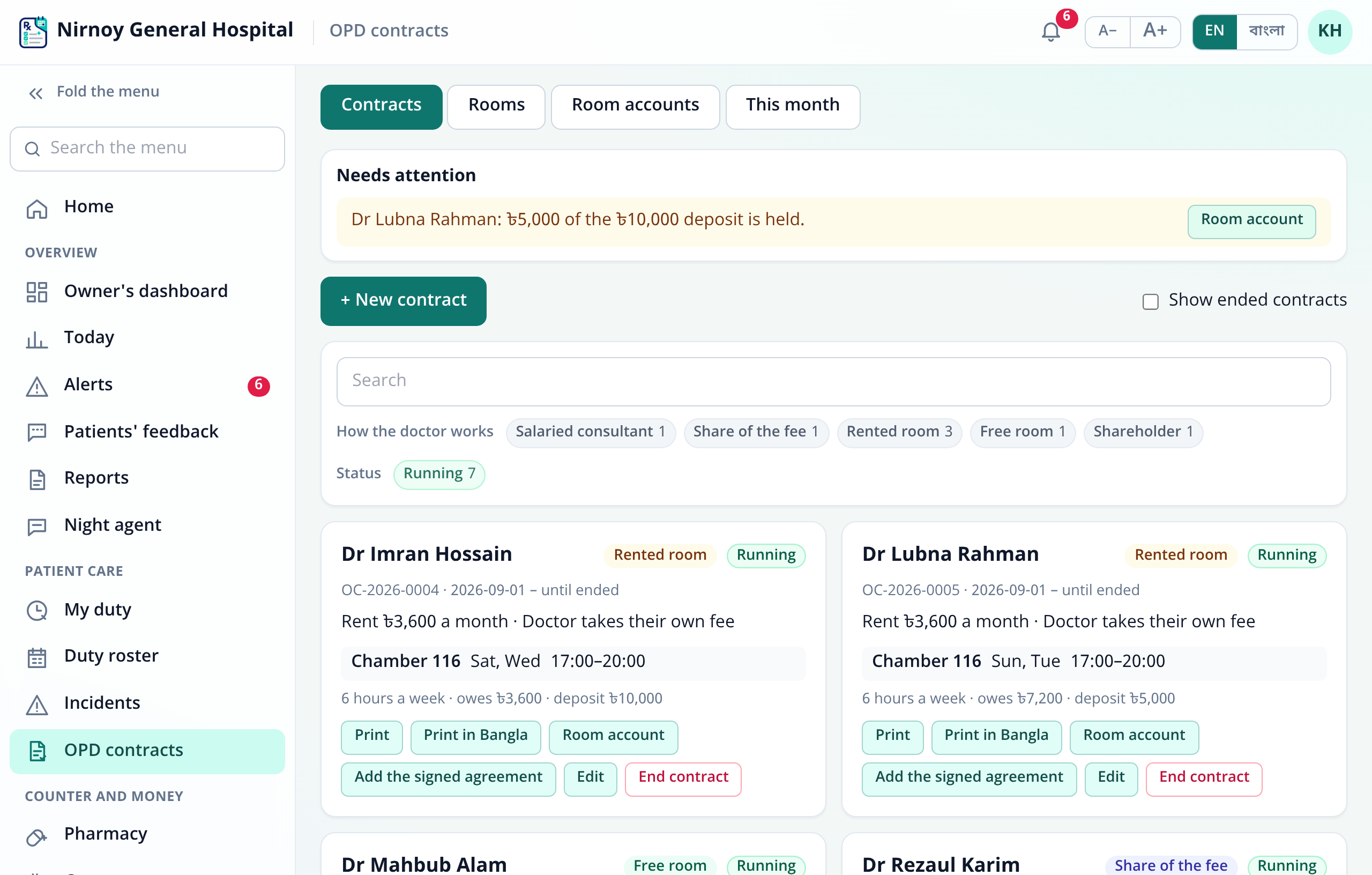
The OPD contracts page has four parts: Contracts, Rooms, Room accounts and This month. It belongs to the accountant and the owner; emergency patients are never under it.
How a doctor works
- Salaried consultant: a monthly salary through payroll; the desk bills the fee and it is the hospital’s. A share of the fee can be given as well.
- Share of the fee: the desk bills the fee, and the doctor’s percent of each one is kept as owed to them.
- Rented room: the doctor’s own chamber for a monthly rent, with a security deposit, notice and a yearly rise; they take their own fee.
- Free room: their own chamber with no rent; the tests their patients have are counted.
- Shareholder: a doctor who holds a share of the hospital; no rent; the fee taken by themselves or by the desk, as the contract says.
For a doctor who takes their own fee, the desk is not offered a bill for their appointments.
Making a contract
- New contract: choose the doctor — their present sittings come into the contract by themselves. Then how they work, the dates and the notice.
- Give each sitting’s days and hours. Find a room shows the rooms free then: rooms free on every day first, one right next to another sitting before them, and where a room is busy on some days, the nearest hours free.
- For a rented room: the monthly rent (offered from the room’s rate where it has one), the deposit, the charge for an extra sitting, the yearly rise, the day rent is raised and the days to pay.
- Saved, the sittings go into the doctor’s timetable and appointments. Print the summary of terms in Bangla or English, and keep the signed agreement (a PDF or photo) with the contract.
Rooms shared by time
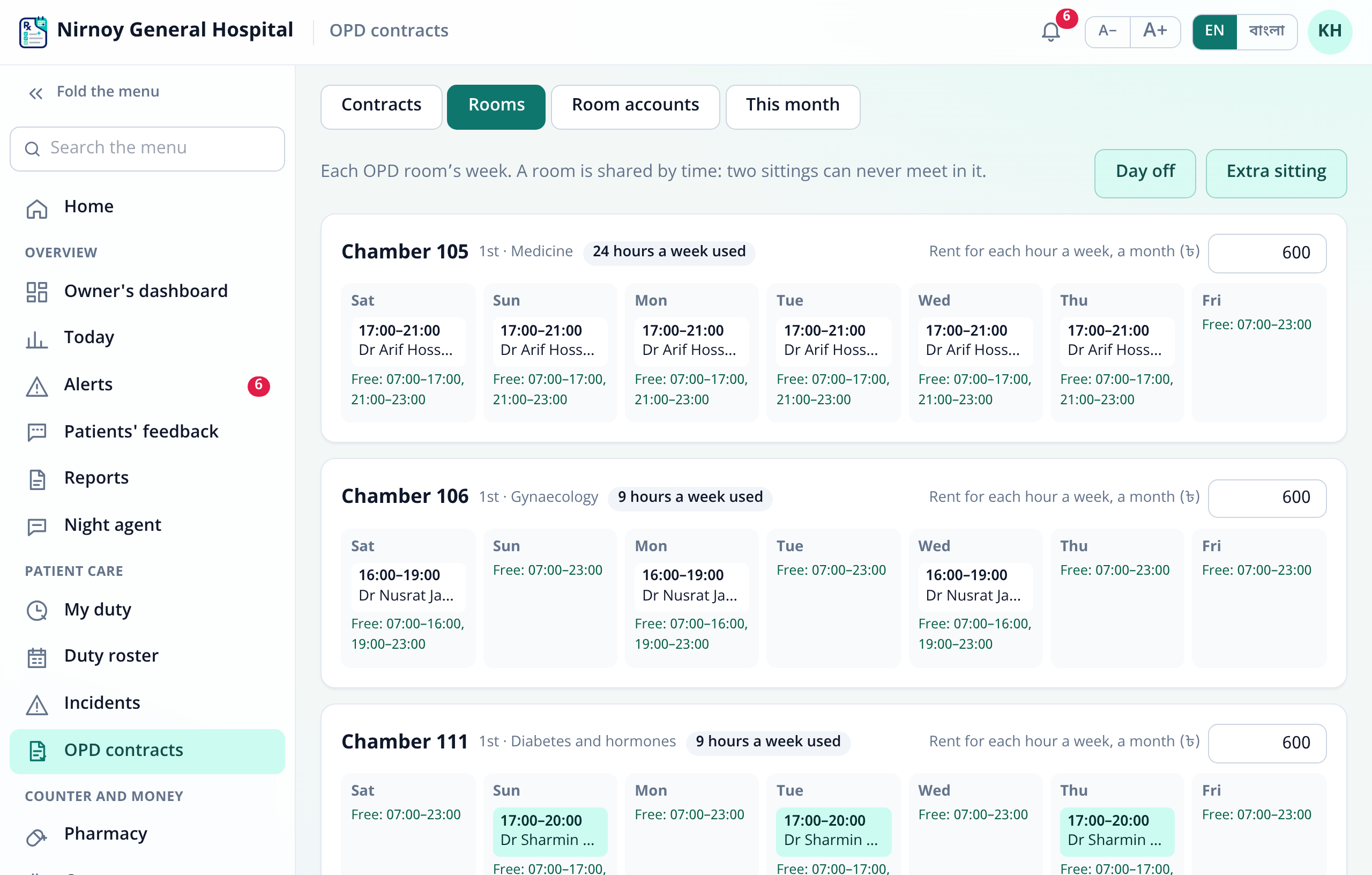
- Two or three doctors can use one room at different hours. Sittings that meet on the same day are refused, saying who has the room then.
- Rooms shows each OPD room’s week: who sits when, the hours still free, and the room’s rate (the monthly rent for each hour a week).
- Day off: a sitting not held on one day, for leave or a swap; nobody can book it, and its room is free that day.
- Extra sitting: a sitting on one date, in a room free then; its patients are booked at the desk. For a doctor who rents, it is charged at the contract’s rate, and waived if called off.
Rent, deposits and the books
- Each month’s rent is raised by the night agent on the contract’s day — once, for the days of the month the contract runs, with its rise after each full year. Raise rent due now does the same by hand.
- Room accounts: receive rent (cash, bank, bKash or Nagad), take the deposit, give it back or keep it against rent owed, and waive with a reason; each has a receipt to print.
- A payment recorded in error is never deleted — it is voided by its mirror image, and both stay on the statement.
- Everything goes to the books by itself: Room rent due from doctors, Room rent from doctors (income) and Security deposits from doctors.
- Needs attention: contracts ending soon or past their end, rent overdue, deposits not all received, and sittings added or changed outside a contract.
This month
Choose a month: each doctor under contract with their sittings and hours a week, the days they sat, the patients seen, the tests their patients had and their value, the fee share, the rent raised, and what came in and what is owed.
If this page did not get you there, write to support — tell us where it stopped making sense and we will fix the page too.