

The hospital and clinic · Doctors and nurses
Monitoring: live signs and critical alerts
Every patient’s signs by unit — live from the bedside monitors, or else the last observations taken; a critical reading sounds and tells the doctor and nurse on duty.
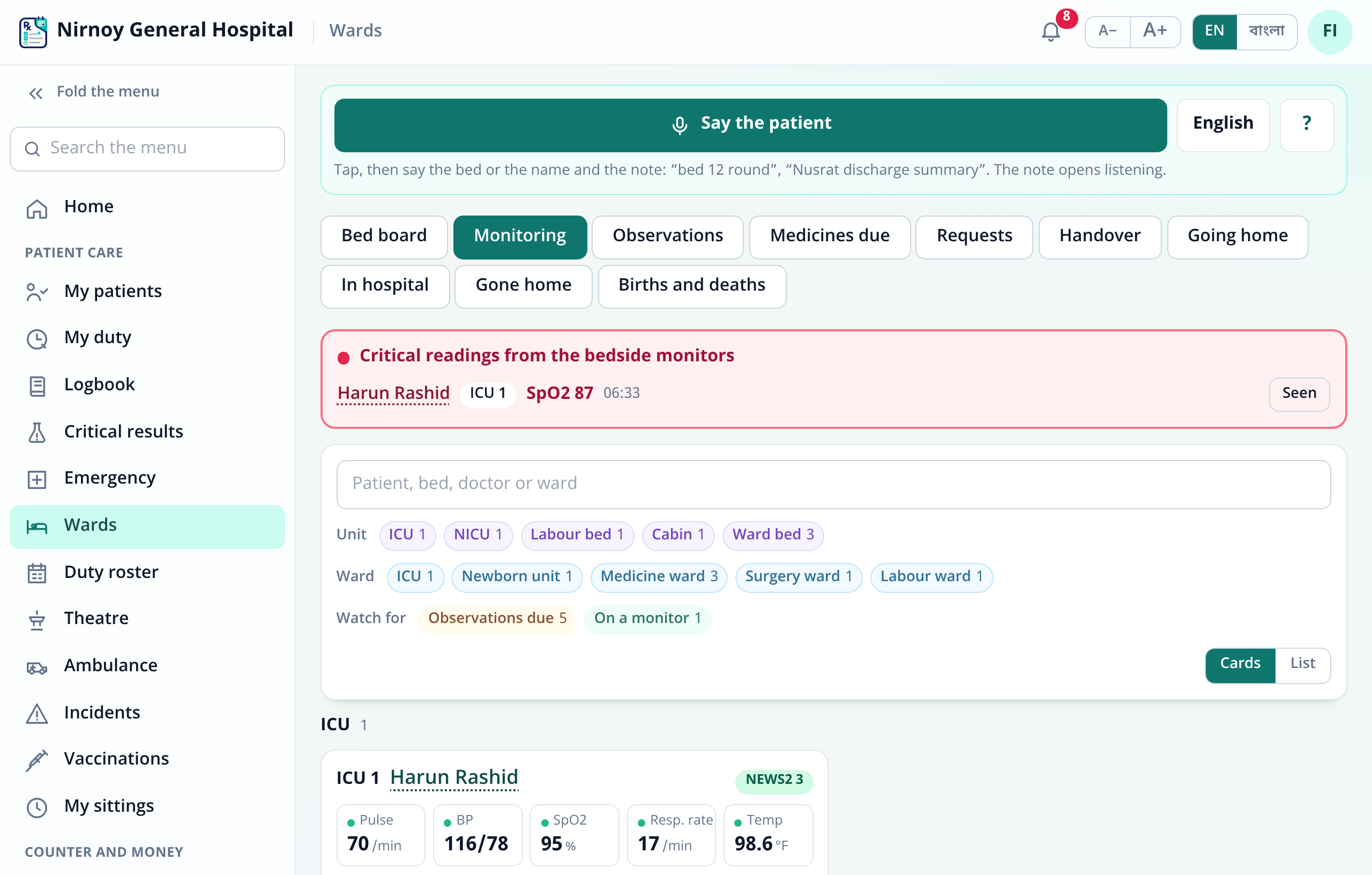
Wards › Monitoring: ICU, CCU, cabins, wards — each patient by unit with pulse, BP, SpO2, breathing, temperature and the early warning score. Shown as cards or a list; found by patient, bed, doctor, unit and what to watch for.
- Where the bed’s monitor is connected the signs are live, with how many seconds ago.
- Without a connection nothing is shown as live — the last observations charted, with when they were taken.
- The stay’s summary shows the signs now beside the bed, and what is critical: allergies, isolation, critical results, and a decision not to attempt CPR if there is one.
Charting
A monitor’s reading never goes into the chart by itself. The nurse looks, chooses how oxygen is given and the consciousness (AVPU), and presses Chart it: the set goes into the observation chart and is scored.
Critical readings
- A sign past the hospital’s line for two readings running sounds on screen with a red message, and reaches the doctors on duty, the consultant and the nurses on duty by phone notice — once in 15 minutes for the same sign.
- A cuff blood pressure is one measurement, so it is told once for that measurement.
- The lines are ready-made where NEWS2 scores 3; the administrator changes them in Ward settings › Bedside monitors. Adults’ lines do not apply to children — they have their own score.
Monitors are connected through the central station’s HL7 output — Mindray, Philips, Nihon Kohden, Edan, Comen or any other HL7; for a make not listed, press Ask for another make.
If this page did not get you there, write to support — tell us where it stopped making sense and we will fix the page too.